

Loading…
March 1 - 4, 2027 | Santa Clara, CA, United States
DVCon U.S. 2027
DVCon is the premier conference on the application of languages, tools, and methodologies for the design and verification of electronic systems and integrated circuits. The focus of the conference is the usage of specialized design and verification languages such as SystemVerilog, Verilog, VHDL, PSS, SystemC and e, as well as general purpose languages such as C, C++, Python, PERL and Tcl. Tools and methodologies include the use of artificial intelligence, machine learning, open-source software, hardware and architecture, testbench automation, hardware-assisted verification, hardware/software co-verification, formal verification, functional safety and security, transaction-level system design, high level synthesis, low power design techniques, 3D chip designs, IP-based SoC design methods, reference flows and Mixed Signal design and verification.
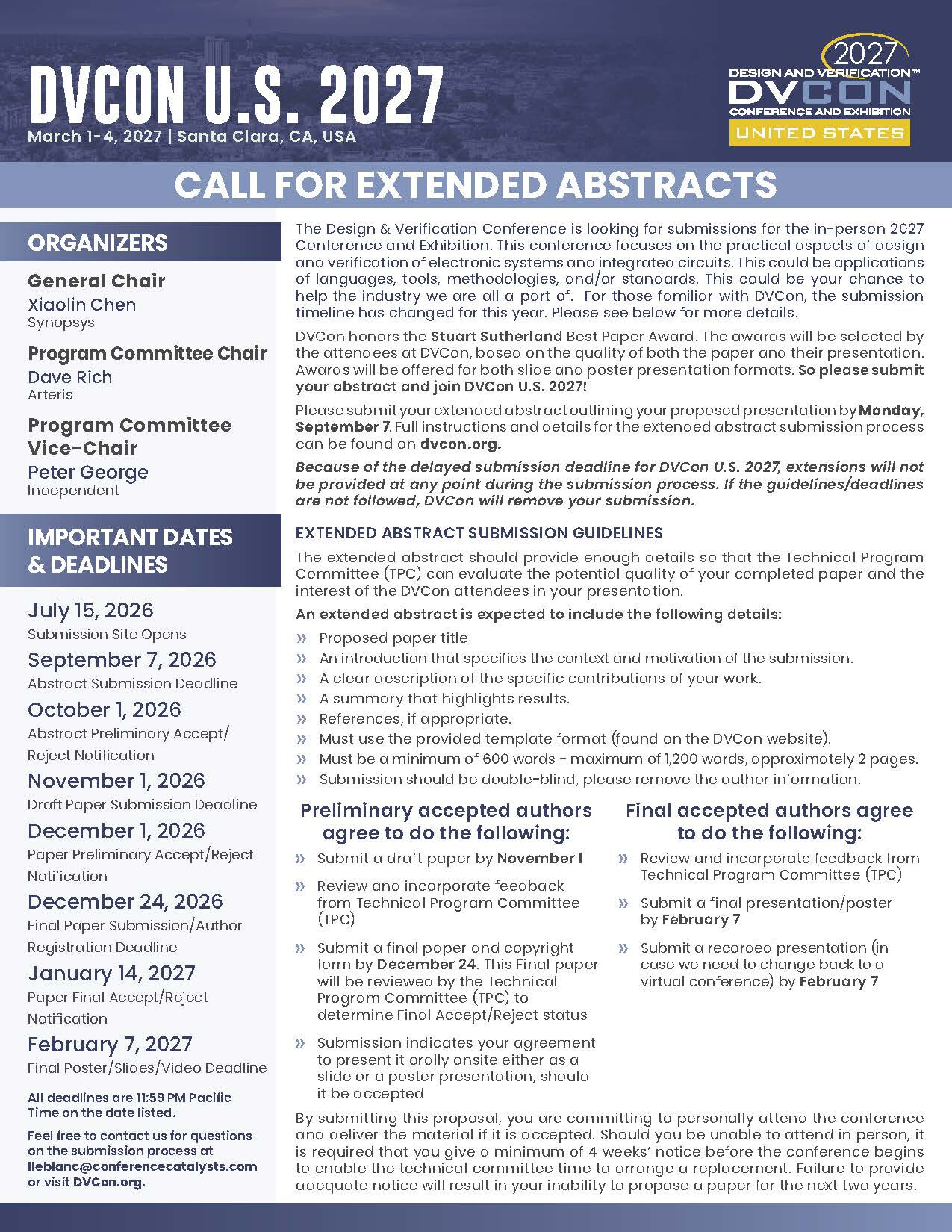
Call for Extended Abstracts
Abstract Submission Deadline: September 7, 2026
The Design & Verification Conference is looking for submissions for the in-person 2027 Conference and Exhibition. This conference focuses on the practical aspects of design and verification of electronic systems and integrated circuits. This could be applications of languages, tools, methodologies, and/or standards. This could be your chance to help the industry we are all a part of. For those familiar with DVCon, the submission timeline has changed for this year. Please see below for more details.
DVCon honors the Stuart Sutherland Best Paper Award. The awards will be selected by the attendees at DVCon, based on the quality of both the paper and their presentation. Awards will be offered for both slide and poster presentation formats. So please submit your abstract and join DVCon U.S. 2027!
Please submit your extended abstract outlining your proposed presentation by Monday, September 7.
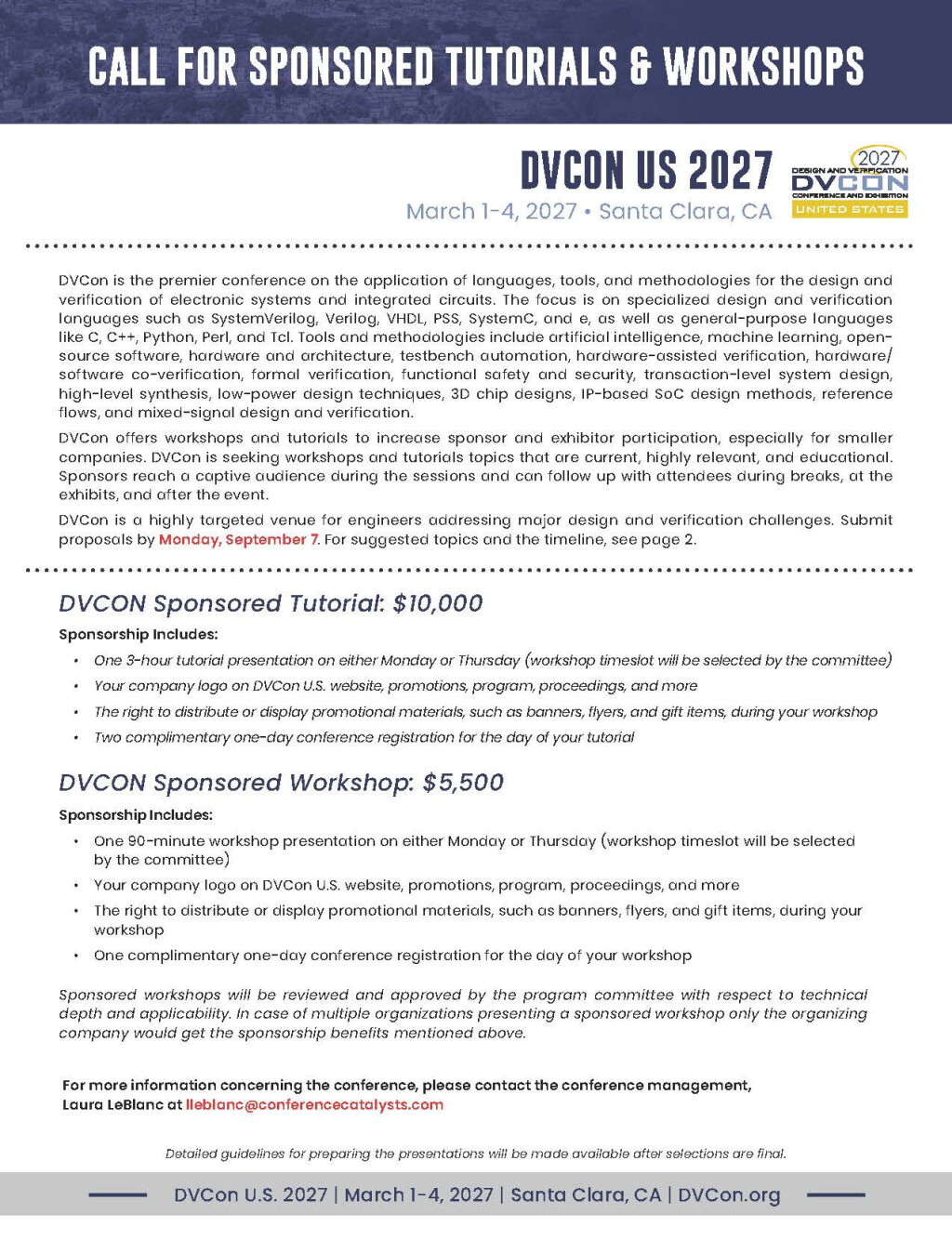
Call for Sponsored Workshops & Tutorials
Proposal Submission Deadline: September 7, 2026
DVCon is the premier conference on the application of languages, tools, and methodologies for the design and verification of electronic systems and integrated circuits. Tools and methodologies include artificial intelligence, machine learning, opensource software, hardware and architecture, testbench automation, hardware-assisted verification, hardware/software co-verification, formal verification, functional safety and security, transaction-level system design, high-level synthesis, low-power design techniques, 3D chip designs, IP-based SoC design methods, reference flows, and mixed-signal design and verification.
DVCon offers workshops and tutorials to increase sponsor and exhibitor participation, especially for smaller companies. DVCon is seeking workshop and tutorial topics that are current, highly relevant, and educational. Sponsors reach a captive audience during the sessions and can follow up with attendees during breaks, at the exhibits, and after the event.
DVCon is a highly targeted venue for engineers addressing major design and verification challenges. Submit proposals by Monday, September 7.
Thank You to Our
Sponsors
Platinum
Gold
Loading…
The Stuart Sutherland Best Paper Award
Loading…
Submission Topics
-
coverage closure
analysis techniques
machine learning-guided coverage
test efficiency
-
scalable formal methods
assertion-driven flows
formal applications
methodology
-
clock/reset-domain crossing techniques
timing constraints
asynchronous logic
domain verification
-
UVM design patterns
reuse strategies
SoC testbenches
Python/C++ co-simulation
DPI
PSS
-
ISO 26262
DO-254
fault injection
safety coverage
verification metrics
-
RISC-V cores
custom instruction set architecture extensions
compliance testing
microarchitecture verification
-
side-channel analysis
data leakage prevention
secure boot
hardware trust modeling
-
automation pipelines
debug triage
result clustering
cloud flows
DevOps/GitOps for verification
-
spec-to-test traceability
audit readiness
natural language processing tools
requirements-driven verification
-
analog/mixed-signal integration
RNMs, co-simulation with digital
behavioral modeling
-
UPF methodologies
dynamic power-aware simulation
power state modeling
assertions
-
pre-silicon validation with FPGA
hybrid flows
debug methodologies
integration challenges
-
hardware/software co-verification
pre-silicon debug
SoC bring-up
software development
virtual prototyping
-
packaging
generating and verifying multiple configurations
DVCon Sponsors
Conference Sponsor
Loading…
Accellera Global Sponsors
Media Sponsors
Loading…
Loading…